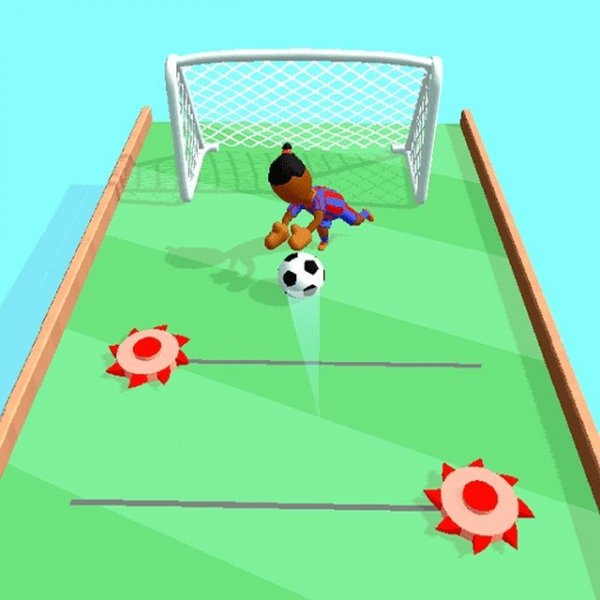
Soccer Dash Sports Challenge
Review
Soccer Dash Sports Challenge works best as a quick-session arcade game rather than a simulation. The narrow pitch and multiple opponents create constant pressure, and the mouse-only control keeps it approachable across devices. Tournament mode adds a competitive layer by giving both sides their own ball. The main limitation is variety: the core loop stays the same across levels, so players wanting deep progression may find it repetitive.
About This Game
One Player Against the Field
Soccer Dash Sports Challenge flips the usual team setup. You control one athlete on a narrow pitch—roughly as wide as a goal—while multiple opponents crowd the same space. The ball stays at your feet as you steer with the mouse, and every defender is a moving obstacle rather than a passive cone. The field is longer than it is wide, so progress happens in a straight line toward the goal, but the density of opponents turns that line into a slalom.
Two Modes, Two Rhythms
Single challenge mode strips the game to its simplest loop: get past the defenders and the goalkeeper, then score. Each goal pushes you to the next level, and the difficulty comes from how the defense arranges itself rather than from new rules. Tournament mode changes the structure. You face opponents from different countries, and each side has its own ball. Field players interfere with both you and your rival, so the match becomes a race to score more goals than the other player while the neutral players disrupt everyone.
Mouse-Only Control
There are no keyboard commands to memorize. Moving the cursor guides your player, and the ball follows as you dribble. That single-input design keeps the game accessible on PC, mobile phones, and tablets through a web browser, and it also means your reaction time depends on how precisely you can move the mouse or trackpad. Full screen support helps by giving you a wider view of the field and the defenders ahead.
Reading the Defense
Success comes from watching how opponents move. Defenders shift into your path, and the goalkeeper covers the goal, so the opening appears when a defender drifts out of position. In tournament mode, the same awareness applies to your rival's ball as well as your own—field players can block either side, which means a well-timed run can help you score while also slowing your opponent. Practicing dribbling and ball control makes those openings easier to exploit.







💬 Comments
0 comments