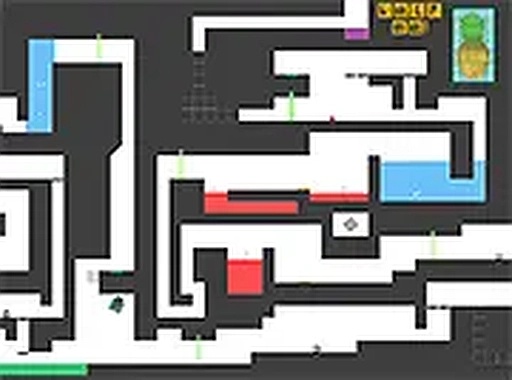
Block Ascent Challenge
Review
Block Ascent Challenge succeeds by removing options. With only left, right, and jump, every screen becomes a small spatial puzzle, and the wall jump is the single skill you must master. Frequent checkpoints make failure cheap, so the game rewards observation rather than memorization. The pixel art and per-section color palettes keep the tower readable. This suits players who enjoy precision platformers with a calm, methodical pace, though those seeking fast action may find the deliberate speed limiting.
About This Game
Climbing With Three Buttons
Block Ascent Challenge limits your movement to left, right, and jump. There is no dash, no double jump, and no run button. To gain height, you press jump while touching a vertical surface, which launches the block upward. This wall jump is the only way to scale the tower, so learning its timing and angle is the first real task. Because the control set is so small, mistakes are easy to understand: you either jumped too early, too late, or from the wrong spot. That clarity is what makes the game feel like a puzzle rather than a reflex test.Obstacles That Ask Questions
The tower's hazards are arranged to teach before they test. Early sections use simple gaps and low walls, giving you room to practice the wall jump without pressure. Later areas combine multiple hazard types, so a single screen might require a specific sequence of jumps. The game avoids sudden traps; instead, each obstacle is readable on arrival and solvable through observation. You can usually pause, look at the layout, and plan a route before moving. That design turns failure into information rather than punishment.Checkpoints and Short Attempts
Frequent respawn points sit throughout the tower. When you fall, you return to the last checkpoint, not the bottom. This keeps backtracking short and encourages repeated attempts at the section that stopped you. The climb is divided into brief segments that can be finished in a few focused minutes, which suits short play sessions. Because checkpoints are generous, the challenge comes from solving each screen, not from replaying large chunks of the tower.Pixel Art With a Purpose
The pixel art style keeps the screen uncluttered. Each section of the tower uses a distinct color palette, so you can visually track how high you have climbed. Platforms and hazards are clearly separated from the background, which matters during fast jump sequences. The presentation is functional rather than decorative, and that supports the gameplay instead of distracting from it.A Steady Difficulty Ramp
New obstacle patterns build on skills you already used lower down. The difficulty rises gradually, so you develop competence before facing tougher combinations. Early success does not guarantee later victory, but the wall jump and timing you learned in the first sections remain relevant all the way up. The result is a climb that feels fair, where progress comes from understanding the mechanics rather than memorizing blind jumps.Editorial Notes
Compatibility
• OS: Windows 10+, macOS 11+, iOS 14+, Android 10+
• Browsers: Chrome 100+, Safari 15+, Edge 100+, Firefox 100+
• Not compatible with Internet Explorer
Tested on real devices ✅ works as expected
Faq
Does Block Ascent Challenge have any movement abilities besides jumping?
No. The game deliberately strips away extra movement options, leaving only left, right, and jump. Wall jumping is the single advanced technique, and it is required to climb. There is no dash, double jump, or sprint, so every gap and wall must be handled with the basic controls.
How does the checkpoint system work in Block Ascent Challenge?
Checkpoints are placed generously throughout the tower. When you fall, you respawn at the last checkpoint you touched rather than at the beginning of the climb. This keeps repeated attempts short and lets you focus on the section that caused the fall instead of replaying earlier parts.
Is Block Ascent Challenge more about reflexes or planning?
Planning is the priority. The control set is simple and the obstacles are designed to be read before you move. Later sections combine hazards that require a precise sequence of jumps, but the game avoids cheap surprises. Observation and patience matter more than fast reactions.
What is the visual style of Block Ascent Challenge?
The game uses a clean pixel art aesthetic. Each section of the tower has its own color palette, which helps you track your progress upward. The simple visuals keep platforms and hazards easy to distinguish, reducing confusion during quick jump sequences.
Does the difficulty increase as you climb higher in Block Ascent Challenge?
Yes. New obstacle patterns appear as you ascend, and they build on skills learned in earlier sections. The ramp is steady, so you develop competence before facing tougher combinations. Skills from the lower tower remain useful throughout the entire climb.
Can I play Block Ascent Challenge in short sessions?
The tower is divided into short sections that can be completed in focused bursts. Because checkpoints are frequent, you can make progress in a few minutes and return later without losing ground. This structure suits players who prefer brief, concentrated attempts over long uninterrupted runs.







💬 Comments
0 comments